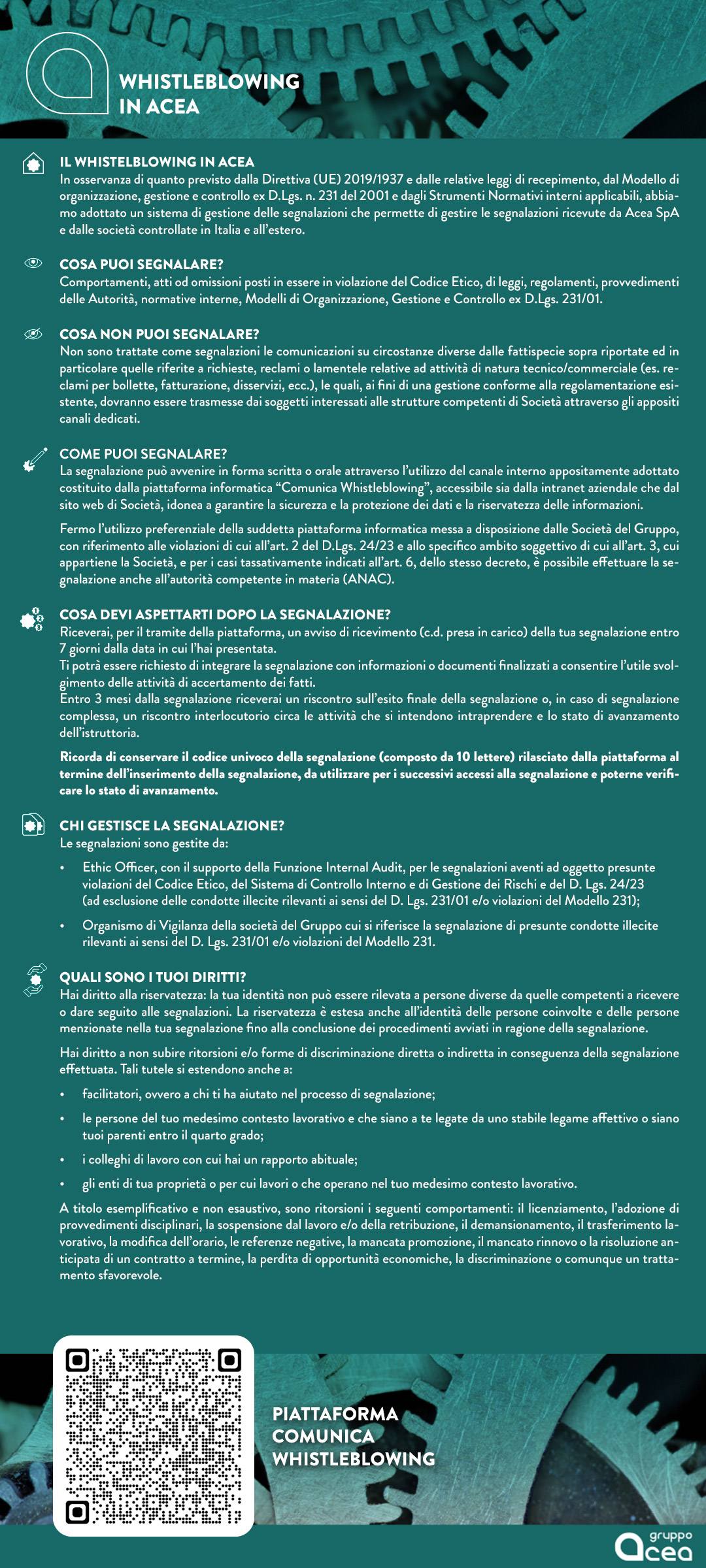
In accordance with the provisions set forth by Legislative Decree 24/2023, through the system adopted, it is possible to report behaviour, acts or omissions that harm the public interest or the integrity of Acea and its subsidiaries, comprising:
- administrative, accounting, civil or criminal offences;
- significant unlawful conduct pursuant to Legislative Decree 231/2001, or violations of the organisation and management models envisaged therein;
- offences falling within the scope of European Union or national acts (as indicated in Annex 1 to Legislative Decree 24/2023, to which reference is made for further details) relating to the following sectors: public procurement; financial services, products and markets and prevention of money laundering and terrorist financing; product safety and compliance; transport safety; environmental conservation; radiation protection and nuclear safety; safety of food and feed and animal health and welfare; public health; consumer protection; safeguarding of privacy and protection of personal data and security of network and information systems;
- acts or omissions adversely affecting the financial interests of the Union;
- acts or omissions concerning the internal market;
- acts or behaviours thwarting the object or purpose of the provisions contained in Union acts.
The scope of alleged violation reports that can be submitted through the reporting system adopted by Acea and its companies is wider than that set forth by Legislative Decree no. 24/2023, which is extended to also include alleged violations of the Code of Ethics, the Human Rights Policy and the body of internal regulations adopted by the various companies.
In order to enable the responsible parties to perform the appropriate analyses and investigations, it is important that the report is timely and detailed and provides specific information with regard to the alleged violations being notified. For example, the report should include details such as date, time, place of the incident, the names of the persons involved and a precise description of the events that took place.
The “whistleblowing reports” do not include communications other than the above mentioned cases and particularly those referring to requests, complaints and grievances regarding activities of a technical/commercial nature (for example complaints connected with bills, invoices, disruptions, etc.) which, in order to ensure that the same are handled in accordance with existing regulations, must be sent to the competent Company departments through the appropriate dedicated channels.