
Remuneration


Acea's remuneration policy provides for the alignment between the interests of management and those of all shareholders, and the compatibility of remuneration systems with the company's short and long-term strategy.

Remuneration policy

Acea’s remuneration policy constitutes an essential lever for supporting the Business Plan. It is conceived as a strategic factor for attracting and retaining professionals with a consolidated knowledge of complex organisational environments and who have different profiles in terms of type and experiences.
The Policy is intended to enhance business performance and encourage the creation of value over the medium-long term for all stakeholders, promoting principles of fairness and sustainability and at the same time supporting the company’s innovation, resilience and competitiveness.

The retribution system therefore aims to ensure consistency between the bonuses paid and the value generated for the community, in response to the demands of our stakeholders.

The incentive systems are designed to recognise the results achieved with respect to strategic objectives, at the same time reinforcing social responsibility and promotion of the sustainable behaviours that characterise the entire Company, together with adherence to business values and people’s commitment.


The guidelines of our remuneration policy are defined according to the following principles:


  • a significant portion of the remuneration for executive directors and managers with strategic responsibilities is linked to the economic results achieved by the company and, where appropriate, the attainment of specific performance objectives indicated by the Board of Directors;

  • a variable, medium-long term incentive system is envisaged (Long Term Incentive Plan or LTIP), based on a rolling arrangement with a three-year vesting period. The purpose of the Plan is to foster loyalty and incentivise management to pursue economic, financial and sustainability results on behalf of the shareholders;

  • as confirmation of the path towards greater integration of sustainability in business activities, from 2020 both the short term and medium-long term incentive plans provide for objectives associated with sustainability issues alongside economic and financial goals. This attention to sustainability was confirmed in the 2026 Policy, which takes into consideration ESG KPIs in keeping with the 2024-2028 Business Plan and the new regulatory guidelines, particularly focusing on the energy transition and grid resilience and water and electricity infrastructures. A composite sustainability objective, accounting for 20% of the total, is present in both short-term variable retribution (MBO) and the third cycle of the 2026-2028 LTIP.

The definition of the remuneration policy takes constant reference:

External Market


To check the consistency of the company's remuneration offer, with a view to both retention and cost containment

Internal coherence


Attention to internal consistency between the level of the salary offer and the complexity of the position held

Job Leveling


Position weighting methodology with the aim of ensuring homogeneous and consistent comparisons and remuneration analyses

How remuneration policy is defined in Acea


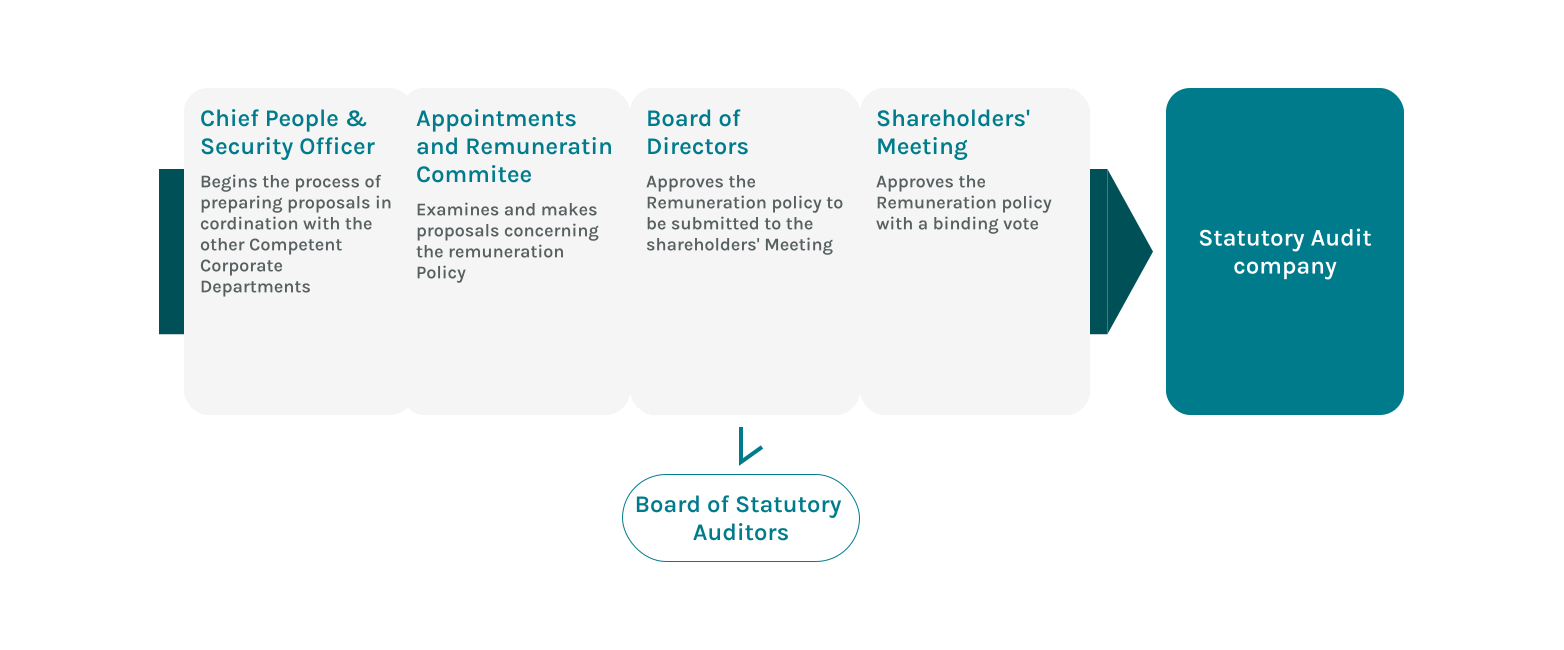
The retribution system is the result of a clear, transparent process, involving remuneration policy proposals put forward by the Appointments and Remuneration Committee and approval of the same by the Board of Directors.

The interaction between these two bodies guarantees the observance of rules, avoiding the occurrence of conflict of interest situations and ensuring transparency thanks to the availability of adequate information.


Pursuant to Article 2389 of the Italian Civil Code, the Annual General Meeting may decide not to intervene in determining the remuneration of executive Directors and Committee members, or may establish a maximum amount, leaving the Board to decide on its allocation.


The AGM also decides:


  • for or against (binding resolution) the first section of the Remuneration Report concerning the remuneration policy;

  • for or against (non-binding resolution) the second section of the said report, concerning the fees paid during the financial period in question to members of the administrative body, the control bodies and, in aggregate form, the executives with strategic responsibilities.

Policy approval process
Processo di approvazione della politica del Gruppo Acea

Long Term Incentive Plan


The 2024-2026 LTIP is a rolling plan, in keeping with market best practices, based on three cycles of three years providing for the payment of a bonus, at the end of the reference three-year period, upon the achievement of predetermined goals. For the third cycle (2026-2028), the indicators used have the same characteristics of the previous two cycles (2024-2026 and 2025-2027) in terms of objectives underlying the incentive plan, related weights and associated incentive curves. The objectives therefore continue to be the cumulative EPS (Earnings per Share), the NFP/EBITDA ratio, cumulative regulated Capex and a composite sustainability objective with a weight corresponding to 20%.

To discover the components of the remuneration assigned to directors and general managers, please see the following table: Remuneration paid to the members of the administration and control bodies, general managers and other executives with strategic responsibilities

Attachments

2026 Report on the Remuneration policy and the remuneration paid

Executive Summary

2025

PDF 1,816 Kb

2024

PDF 4,174 Kb

2023

PDF 5,711 Kb

2022

PDF 3,720 Kb

2021

PDF 3,714 Kb

2020

PDF 3,238 Kb

2019

PDF 5,384 Kb