

Double materiality and stakeholder engagement

Listening, dialogue and participation on the part of our stakeholders are key elements for orienting our strategic choices, pursuing company objectives, improving risk management, enhancing brand reputation and creating shared value over time.
People attending a conference People attending a conference

The double materiality analysis (DMA) is the process whereby we identify the material impacts, risks and opportunities (IRO) along the value chain, according to a double perspective of impact relevance and financial relevance, in line with the CSRD and the EFRAG guideline.



In 2025 we obtained the results of the 2024 DMA by updating the context analysis and the annual risk assessment process, which confirmed the validity and adequacy of the material IROs and the consequent relevance of all the environmental, social and governance ESRS discussed in the Sustainability Report, as envisaged by the Standard.


The DMA comprises the following main stages:


  • analysis of the internal and external context, including benchmarks and regulatory framework;


  • identification of ESG topics and related impacts, risks and opportunities;


  • through dedicated focus groups invece di by way of a focus group;


  • evaluation and quantification of ESG risks and opportunities, via the company risk management framework;


  • definition of material IROs; 


  • sharing of the DMA results with the governance bodies and approval by the Board of Directors.
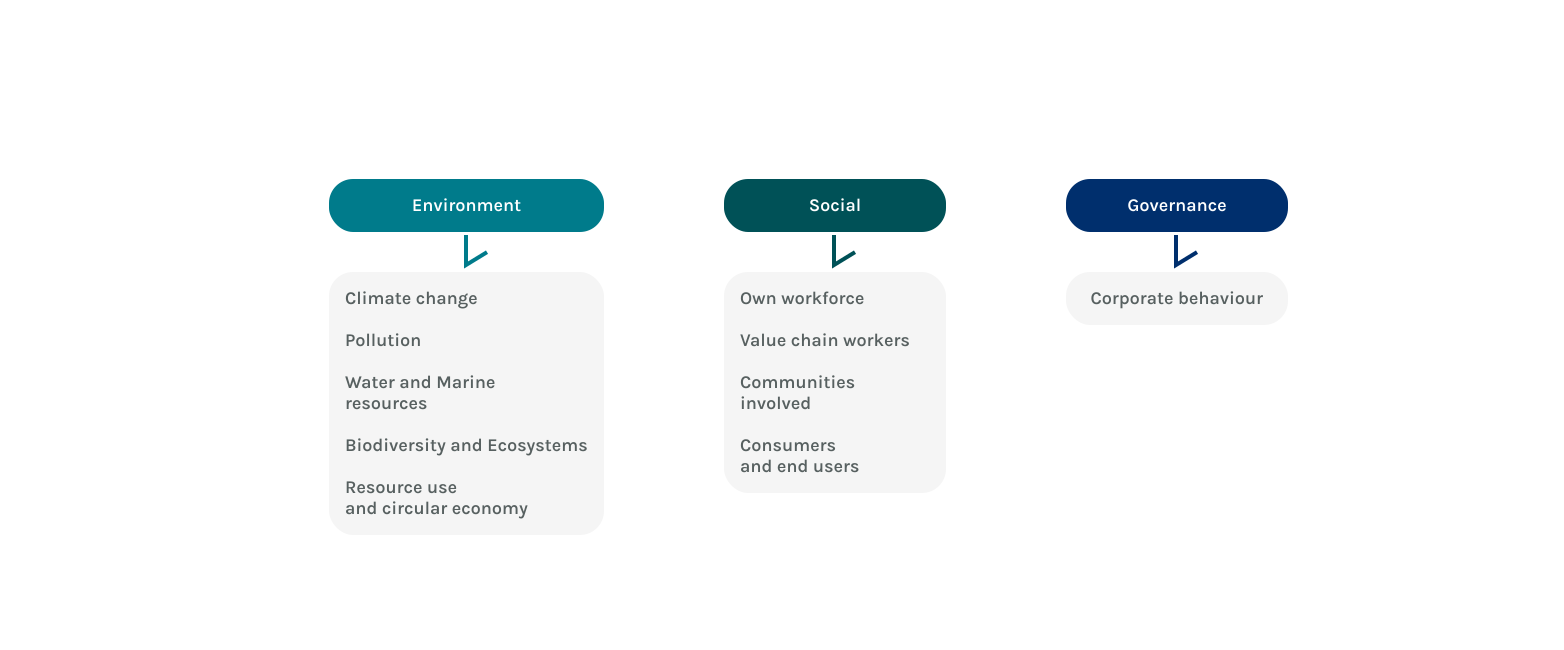
Diagram on the impacts of the Acea group for the categories environment, social and governance. For environment there are climate change, pollution, water and human resources, biodiversity and ecosystems, use of resources and circular economy. For social there are own workforce, workers in the value chain, affected communities, consumers and end users. Finally, for the governance category there is the impact of business conduct.

Learn more about double materiality

Sustainability Report from the 2025 Consolidated Financial Statement

Stakeholder engagement: 
a structured approach

The dialogue with stakeholders is an integral part of our business model and helps to orient our strategic choices, enhance risk management and generate shared value for the territories and communities served.


The approach, based on principles of inclusion, transparency, equity and attention to ethical, environmental and social aspects, is formalised in the “Principles and Values of Stakeholder Engagement”, which steer our operations in a consistent and strategic manner. 

The management model

Based on these principles and values, the Stakeholder & Customer Unit acts as a specialist expertise hub  with regard to stakeholder engagement and supports the holding entities and the operating companies, placing at their disposal methodologies, dedicated tools and best practices. 


Each year the Unit prepares an internal report containing all the main initiatives carried out.

Download the document

Principles and values of stakeholder engagement

Who are our stakeholders


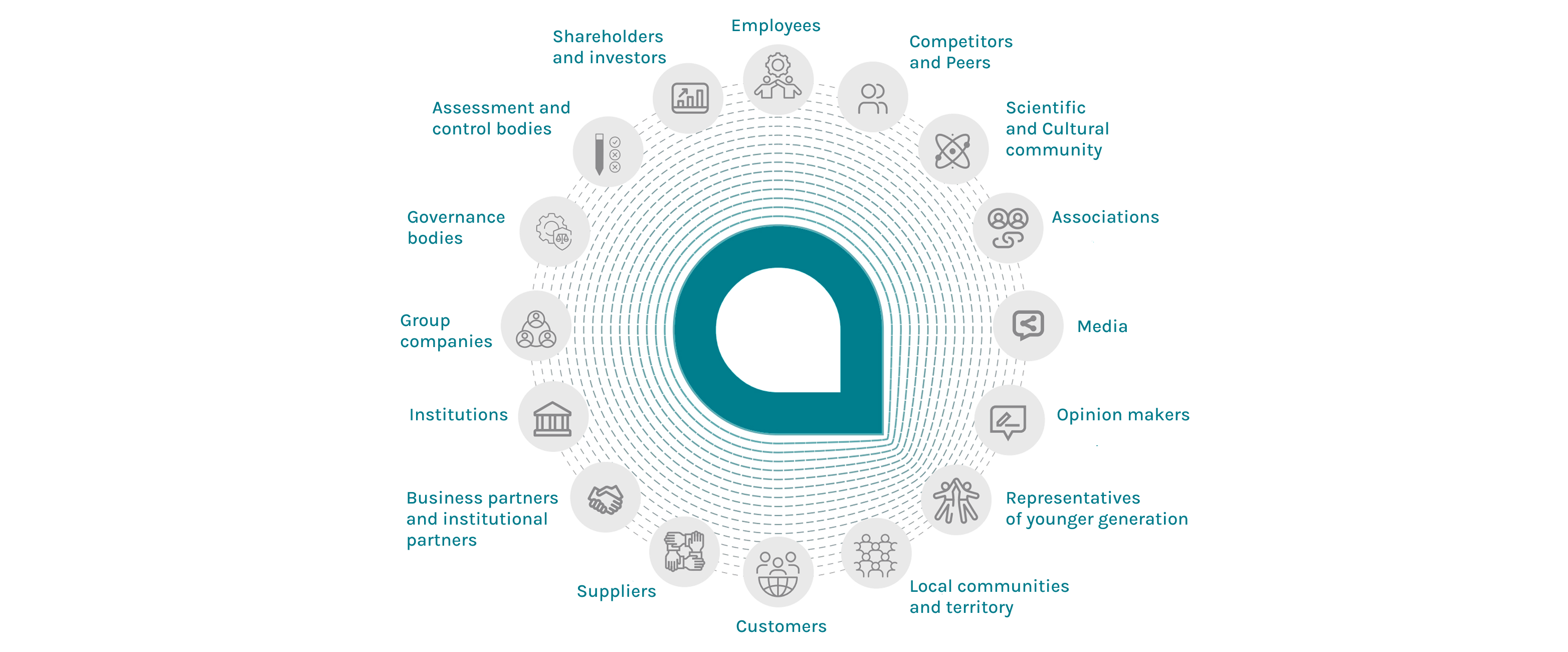
The Stakeholder Map is the tool that charts our stakeholders, dividing them into categories and subcategories, also taking into account the specific nature of our various businesses. It is put together through an analysis of the company’s relationship network, with the involvement of top managers and operating personnel.

The stakeholder engagement process


The stakeholder engagement process is regulated by a company procedure, developed in accordance with the AA1000 Stakeholder Engagement standard.

Each project is handled by the reference structures, which follow the related planning, implementation and management, with different levels of responsibility according to strategic materiality. 

 The main phases of the stakeholder engagement process are as follows:

Definition of the object and the goals to be achieved through stakeholder engagement:


the purpose of these activities is to define a clear vision of the stakeholder engagement motivations, in keeping with the broadest objectives of the strategy, and to identify and understand the specific issues to be considered during the stakeholder engagement process.

Identification, analysis, prioritisation and mapping of the stakeholders to be engaged:


this serves to identify the stakeholders who must and can be involved, analysing and displaying ongoing interests, influence, importance, relations and connections between them and the company. The analysis also covers the steps for organising and prioritising the various stakeholders. The data produced will be used to create a map of relevant stakeholders, an essential and strategic tool for the planning of engagement activities.


Definition of the level of engagement and the engagement tools:


via the mapping of relevant stakeholders it is possible to understand the most appropriate ways of involving them and communicating in an effective manner.

Planning, implementation and management of engagement activities:


set out below is a relevant stakeholder engagement plan, consistent with the company's strategy, objectives and aims, for the purpose of implementing the said engagement process. Having organised the involvement, the engagement activities are operationally put into effect. The stakeholders are then engaged according to the procedures envisaged by the tools identified.

Assessment and continuous improvement:


at the end of the process a detailed analysis of the results is carried out, in order to identify potential opportunities for improvement. The collection of feedback from the parties involved is also envisaged.

Projects carried out

In 2025 we carried out 16 stakeholder dialogue and discussion initiatives, mainly with regard to:


  • NRRP territorial projects
 
  • operating activities (for example, connected with district heating and grid flexibility)


  • corporate volunteering programs
     
  • water and environmental awareness and education campaigns