


Sustainability integrated into our business
Sustainability is an integral part of our business strategy: we ensure the resilience and safety of our infrastructures, we protect water and the environment, we create shared value for people, suppliers and the communities.
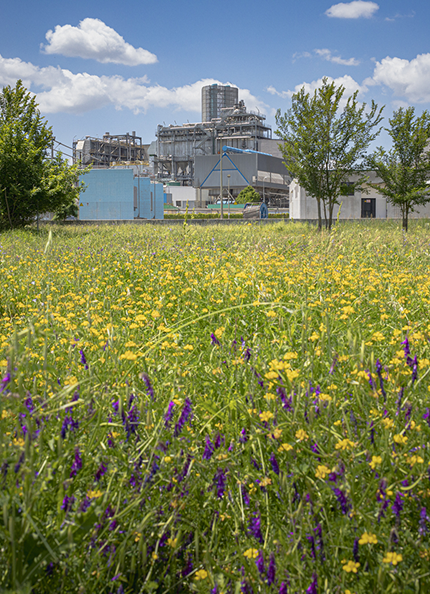
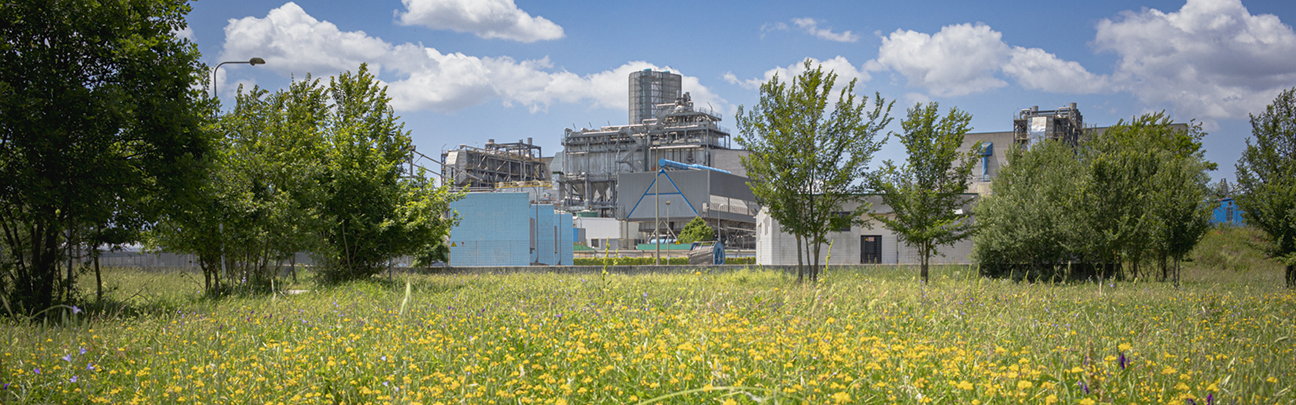
"To develop and manage safe and sustainable infrastructure and, via our people, to ensure essential resource access and circularity for residents, businesses and the local community”: this is the objective defined in our “Green Diligent Growth” Business Plan.
Water, energy and environment are our business areas. On a daily basis, we commit to ensuring the management of these fundamental resources according to a logic of efficiency and innovation, integrated with our vocation of serving the areas and the communities where we operate, from a perspective of the company’s responsibility towards the creation of shared value.
Accordingly, attention to the environment, resources, communities and people is the cornerstone of our activities and sustainability is therefore a fundamental and indispensable prerequisite for all our decisions.
Our sustainability strategy is based on four essential pillars which reflect the guiding principles of the company’s business model, with transversal leverages characterised by innovation, as enabling driver of the transition processes, and by the centrality of people, an aspect that ensures a responsible, fair and inclusive transition.
Our 2024-2028 Sustainability Plan, approved by the Board of Directors in November 2024, is centred on impacts, risks and material opportunities for Acea in close correlation to the Business Plan and formalises our objectives with regard to positively impacting people, the environment and the territories, our targets and our investments.
The initiatives are monitored on a six-monthly basis and submitted to the Ethics, Sustainability and Inclusion Committee, so as to ensure the ongoing supervision of progress with respect to targets and the definition of corrective actions, wherever necessary.
The Sustainability Plan objectives are our priority with a view to integrating ESG into our industrial strategy and our business decisions, fostering our commitment to a positive impact on people, the environment and the community. The Sustainability Plan’s strategic objectives represent the priorities whereby Acea contributes to the pursuance of sustainable success, integrating environmental, social and governance dimensions into its activities and decisional processes.
The Plan is divided into action lines required on the part of the operating companies or the holding entities, indicating the related targets and investments anticipated to guarantee achievement of the objectives.
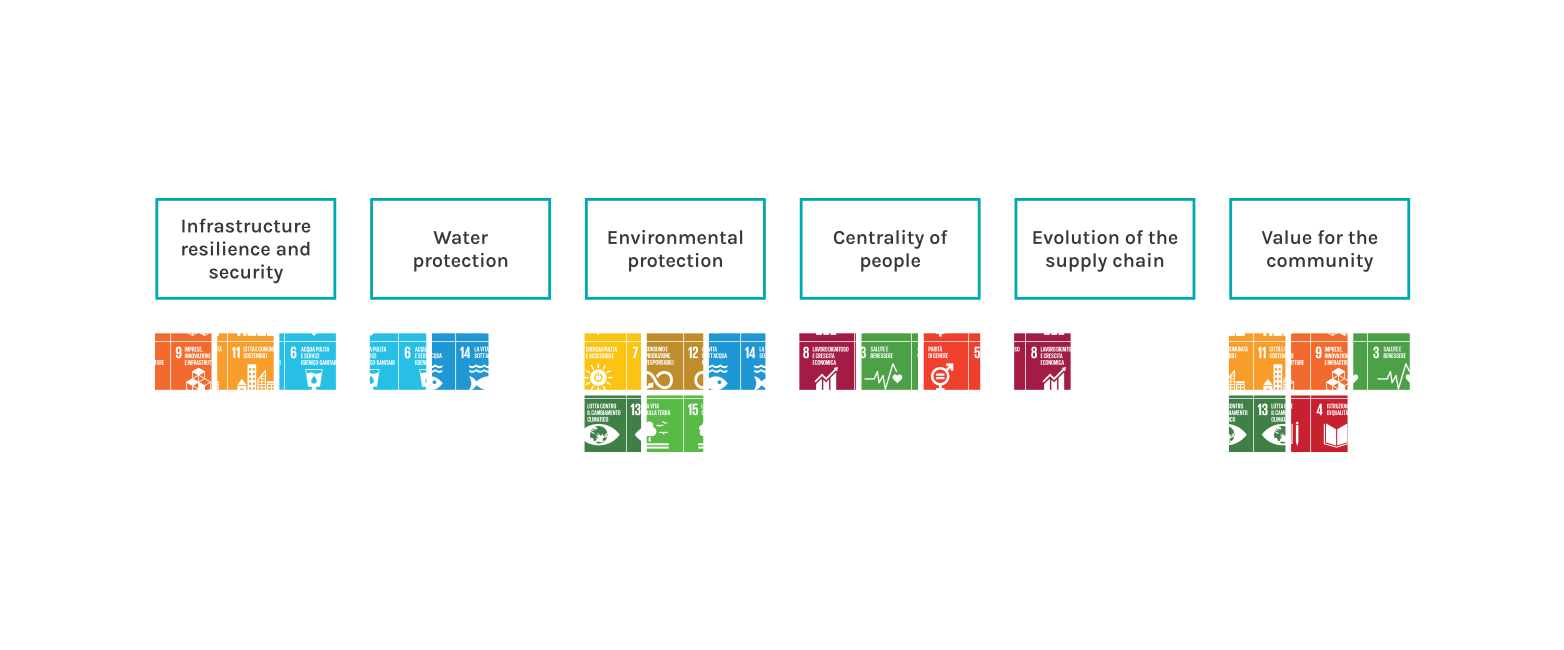
INFRASTRUCTURE | WATER | ENVIRONMENTAL | CENTRALITY | EVOLUTION | VALUE FOR | |
|---|---|---|---|---|---|---|
Action line
|
|
|
|
|
|
|
The first three goals - “Infrastructure resilience and security”, “Water protection” and “Environmental Protection”- are closely connected to our core businesses and our role as an infrastructure operator. They generate environmental benefits that facilitate the transition to a sustainable economy, also with a view to mitigating and adapting to the effects of climate change. At the same time, they support the improvement of services provided to the territory and to the communities, by upgrading, enhancing the safety and increasing the resilience and adaptability of water and electricity infrastructures.
The other three strategic goals - “Centrality of People”, “Evolution of the supply chain”, “Value for the community”- are focused on the creation of shared value. In this connection, Acea promotes the well-being and development of its people, the suppliers and its areas of operation. For the first time, the Sustainability Plan is extended to also include our overseas companies, introducing specific environmental and social targets for the realities in which we operate and where we can make a significant contribution, with particular attention to supporting and developing the local communities.
Download the Sustainability Report from the 2025 Consolidated Financial Statements

"Acea manages natural resources and provides public utility services by way of an integrated approach that harmonises the management of environmental and social impacts, risks and opportunities. Sustainability is at the core of our strategies and business decisions as a lever of long-term innovation, resilience and value creation, for the company, the territories and the communities where we operate."
Caterina Dentoni Litta
Acea Head of Sustainability
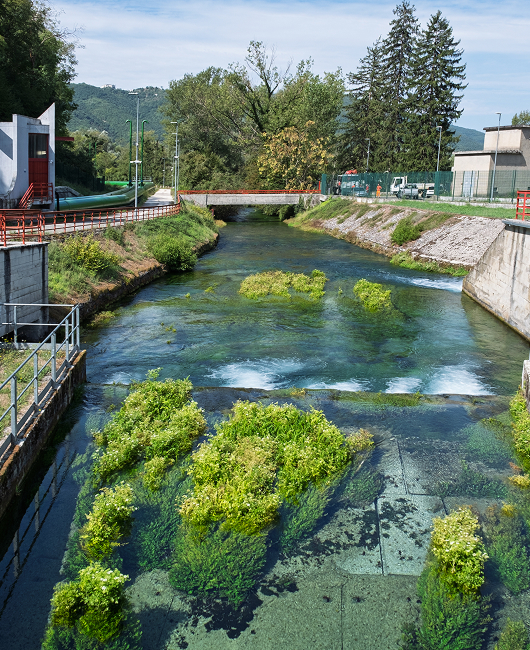
We consider sustainability to be reflected in a series of material interventions to enhance the quality of services, safeguard resources and support the development of the areas where we operate. This commitment is expressed through the upgrade of water infrastructures, the doubling of the Peschiera-Capore aqueduct, the adoption of innovative solutions for the reduction of water losses, the development of energy renewables and initiatives dedicated to training and the involvement of people and communities. A combination of actions that reflect our strategic priorities and our long-term undertaking to serve Italy as an infrastructure operator of excellence.
The Peschiera-Capore pipeline doubles |
INFRASTRUCTURE RESILIENCE AND PROTECTION
An essential project for securing the water supply of the Capital.
The Peschiera-Capore pipeline doubles
|
|---|---|
Reduction of water losses
|
WATER PROTECTION
The management of networks and facilities through artificial intelligence to monitor the health status of our assets.
|
Renewable energy production
|
ENVIRONMENTAL PROTECTION
We aim to grow in the photovoltaic sector with 870 MW installed by 2028, contributing towards a low-emissions economy.
|
Acea Scuola |
VALUE FOR THE COMMUNITY
We work to raise awareness among younger generations about respecting natural resources and addressing environmental issues by organising projects such as “Water Education”, which in 2025 involved primary and lower secondary schools throughout Italy.
|
Acea Academy |
CENTRALITY OF PEOPLE
Our training programme, focused on business management and leadership, digitalisation and robotics, was further enhanced in 2025 with the first Executive Master in Water Management, aimed at developing strategic and technical skills for the sustainable management of water resources, and with the first Corporate Master, which, through a tailored academic programme, enables the development of specific skills and knowledge in the utilities sector.
|
Sustainability is integrated into our governance system, with a view to promoting the creation of long-term value for the benefit of all our stakeholders, the environment and the territories where we operate. Our management incentive systems provide for specific ESG targets in the short and long-term variable remuneration plans (MBO and LTIP), confirming the alignment between economic performance and social and environmental goals.

We operate in a responsible manner in observance of shared ethical and social principles, by adopting guidelines and rules and monitoring their application.
Definition and revision of value codes and policies: code of ethics, human rights policy, anti-corruption policy, integrated management and sustainability systems policy, etc.
Training and monitoring of effective policy application
We integrate sustainability into our decisional processes and operating activities, via specific structures and tools and continuous monitoring systems.
We raise awareness and train our people, associates, suppliers and stakeholders with regard to sustainability, causing it to become a value shared and effectively applied on a daily basis:
Training of employees and certification of their ESG competencies via the «Sustainability professionals» course
Involvement of internal and external stakeholders in sustainability projects and initiatives
Development of an increasingly sustainable value chain
Via dedicated structures, policies and procedures, we undertake to operate responsibly vis-à-vis the environment and the community, monitoring the related impact and guaranteeing external transparency.
The Ethics, Sustainability and Inclusion Committee advises the Board of Directors on ESG issues, promoting the integration of sustainability into the company’s business strategy and culture. It supervises communications with stakeholders, monitors implementation of the Sustainability Plan and oversees the adequacy and application of the Code of Ethics.
The Equality, Diversity, Inclusion & Belonging Committee steers the cultural trend and the development of a work environment based on understanding, inclusion, fairness and promotion of diversity and the sense of belonging, also through application of the specific Policy.
The mission of the Chief Risk Management & Sustainability Officer, who reports directly to the Chief Executive Officer, is to ensure the valorisation of ESG criteria within the business, integrating sustainability into operational strategy and management, preparing the sustainability report and contributing towards Acea’s positioning in ESG and sustainable finance ratings.
The Code of Ethics lays down values and rules of conduct which guide our operations, ensuring correctness, transparency and integrity as regards the relationships with stakeholders and the pursuance of strategic objectives.
By way of our Human Rights Policy, we undertake to protect the human rights of communities, workers and suppliers and to ensure the sustainable management of natural resources and environmental protection. The Policy is defined in observance of the main references on the subject, including the UN, OECD, ILO and Global Compact guidelines.
The Integrated Management and Sustainability Systems Policy outlines our principles and values, valorising the commitments with regard to quality, environment, workers’ health and safety, energy management and customer satisfaction as an integral part of the management systems that we have adopted for governing our activities.
The Sustainable Procurement Policy encourages the involvement of suppliers and their supply chain in a partnership collaboration, with a view to enhancing synergies and reducing potential negative environmental and social impacts associated with the procurement chain.
Thanks to our AI Governance Policy, approved in 2025, we steer innovation by way of an ethical, safe and transparent use of artificial intelligence and of the new technologies, establishing roles, responsibilities and promoting an AI culture based on equity and respect for the fundamental rights of people.
For Acea, sustainable finance represents a strategic lever in support of the business plan, geared towards sustaining the transition processes, the enhancement of resilience and infrastructure security and the protection of water resources.
By integrating industrial strategy, ESG objectives and financial structure, the Group fosters the creation of long-term value for stakeholders and for the communities served.
This approach was launched in 2021 with the Green Financing Framework and consolidated in 2025 with the Green and Blue Financing Framework, which expanded the perimeter of eligible investments, valorising the contribution to the blue economy. The strategy is also reflected in the composition of private and public funding sources, with increasing recourse to instruments that meet ESG requirements, such as green bonds and loans, NRRP loans and financing provided by the European Investment Bank, in line with the Group’s financial stability.
The investments financed are fully compatible with EU Taxonomy, particularly as regards the Water and Grids businesses, contributing towards mitigation and adaptation to climate change and the improvement in service efficiency.
Through sustainable finance, Acea reinforces its commitment to contribute towards a resilient, inclusive and low-emissions infrastructural development, ensuring consistency between financing methods, investment decisions and long-term sustainability goals.